The best ERP software in Bangladesh depends on your industry. Garments and textile factories usually need a garments-specific ERP with merchandising, buyer orders and export documents. Manufacturers, traders and distributors need strong inventory, accounting and NBR VAT-ready reporting, which local vendors such as PinTech ERP and G-ERP highlight. Large or multi-country groups often choose SAP Business One, Oracle NetSuite or Microsoft Dynamics 365. Growing service, retail and logistics SMEs that mainly need people, sales, projects and money on one login can often use a business operating system such as SigmaTurn instead.
This guide compares your options by business type, explains what a Bangladeshi ERP must handle (VAT, multi-branch, multi-currency, payroll), and gives you a checklist and an implementation plan. Disclosure: GiveTurn builds SigmaTurn, and we say plainly where an ERP is a better fit than our product. Vendor details are the vendors' own public claims, read in September 2026, so verify them in a demo with your data.
Key takeaways
1) Pick by industry and process first, brand second. 2) Ask every vendor to demo your real workflow, not a generic one. 3) Check VAT (Mushak), multi-branch, multi-currency and payroll handling against your actual documents. 4) Get a written three-year total cost and three customer references in your industry.
What is ERP software?
ERP (enterprise resource planning) software is a system that runs a company's core operations on one shared database. Typical modules cover accounting, inventory, sales, purchasing, production, HR and payroll, and reporting. Because every module reads the same data, a sale updates stock, accounts and reports at once instead of being re-entered in several places.
ERP vs accounting software vs business operating system: what is the difference?
| Factor | Accounting software | ERP | Business operating system |
|---|---|---|---|
| Focus | Books, invoices and tax | Finance, inventory, purchasing and production | People, sales, projects and finance together |
| Best for | Small firms with simple needs | Manufacturers, traders and process-heavy firms | Growing service, retail and logistics SMEs |
| Set-up | Fast | Often weeks to months | Typically days to weeks |
| Strength | Simple and familiar | Depth in operations and supply chain | One login and one data model across departments |
| Weakness | Limited beyond accounting | Cost and complexity | Less depth for production and industry workflows |
For a full explanation of the third column, read our guide to the best business operating system in Bangladesh.
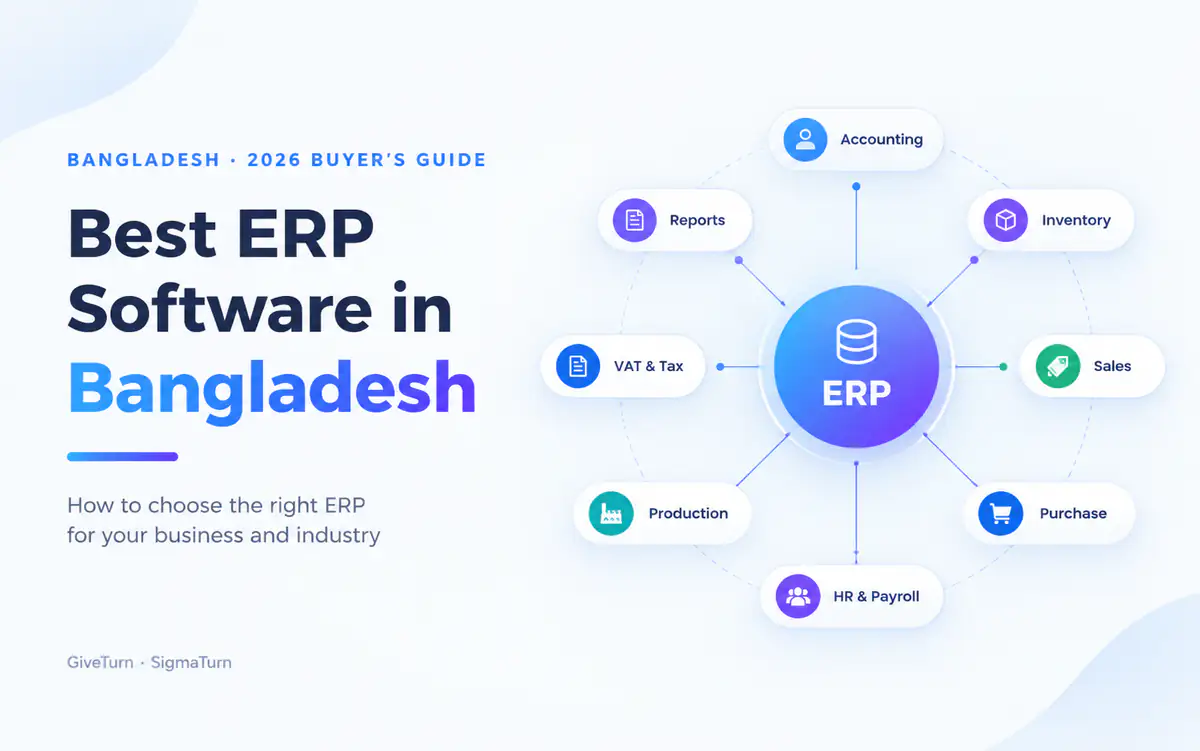
Which ERP modules does a Bangladeshi business need?
- Accounting and finance: ledger, payables, receivables, bank reconciliation, budgets and financial statements.
- Inventory and warehouse: stock levels, multiple warehouses, batch or serial tracking and reorder alerts.
- Sales and purchase: quotations, orders, delivery, supplier bills and purchase approvals.
- Production or manufacturing: bills of materials, work orders and costing, if you make products.
- HR and payroll: attendance, leave, overtime and salaries. See our HR and payroll software guide.
- CRM: leads and customers. See our CRM software guide.
- Reporting and MIS: live dashboards for owners and managers.
What must an ERP handle for Bangladesh specifically?
- VAT and NBR reporting. If you are VAT-registered, ask to see invoices and returns in the formats the National Board of Revenue (NBR) expects, including the "Mushak" forms, and how VAT and tax deducted at source are handled.
- Multi-branch and multi-warehouse. Branch-level stock, accounts and permissions with a consolidated view for the owner.
- Multi-currency. Essential for importers and exporters, with exchange rate handling on invoices and payments.
- Local payroll rules. Overtime, leave, festival bonus, provident fund and tax as your company applies them.
- Industry workflows. For garments: merchandising, buyer orders, bills of materials, back-to-back LC and export documentation.
- Local payments and integrations. Banks, bKash, Nagad, payment gateways, POS and e-commerce.
- Local support. Support in Bangladesh time, on-site training and a team that can customise quickly.
What is the best ERP for your type of business in Bangladesh?
Best ERP for garments and textile (RMG) factories
Garments factories need merchandising, buyer and style management, bills of materials, production tracking, inventory across fabric, trims and finished goods, and export documentation such as back-to-back LC. Pridesys positions PrideTex as a garments ERP, and Bangladeshi roundups also list other garments-focused systems. Require: a demo of a full order from buyer PO to shipment, and references from factories of a similar size.
Best ERP for manufacturing
Manufacturers of foods, plastics, steel, pharma and similar products need production planning, costing, inventory with batches, quality checks and accounting that ties directly to stock. PinTech ERP lists many manufacturing industries, and G-ERP describes itself as NBR-compliant across manufacturing, garments and trading. Require: costing that matches your bill of materials and a walkthrough of one production run.
Best ERP for trading and distribution
Traders and distributors need fast order-to-cash, credit control, multi-warehouse inventory, supplier management and reliable VAT reports. Require: speed for high-volume invoicing, route or salesperson reporting and clear receivable ageing.
Best ERP for retail, pharmacy and restaurants
Businesses with counters and outlets need POS, batch and expiry tracking, and multi-outlet stock. Require: a POS that works reliably during peak hours and connects to inventory and accounts.
Best ERP for real estate and construction
Real estate and construction firms need project costing, contractor and supplier billing, and instalment tracking for buyers. PinTech ERP lists real estate and construction among its industries. Require: project-wise budgets and cash-flow reports.
Best ERP for service SMEs and growing companies
If you sell services, run branches, or mainly need HR, sales, projects and accounting rather than production, a full ERP may be more than you need. Cloud ERPs such as Biznify and PrismERP target this segment, and a business operating system such as SigmaTurn is another route. Require: quick set-up, clear pricing and a system your team will actually use.
Best ERP for large groups and multi-country operations
Large groups, multi-entity companies and firms with international audit needs usually look at SAP Business One, Oracle NetSuite or Microsoft Dynamics 365, typically through local implementation partners. Require: a proven partner, a realistic budget and a clear governance plan.
What are the best ERP software options in Bangladesh in 2026?
PinTech ERP: broad module coverage with NBR and VAT-ready accounting
PinTech ERP, developed in Dhaka since 2011, lists accounting, inventory, HRM and payroll, CRM, supply chain, project management and MIS in one system. It offers cloud and on-premise options, states NBR and VAT-ready accounting with multi-currency support, and lists dozens of industries from real estate and manufacturing to pharma and retail. It also lists dedicated local support and training. Best for: manufacturers, traders and project businesses that want a local vendor. Check: the Bangla interface, which the page we read did not detail.
PrideERP and PrideTex by Pridesys: local ERP with a garments focus
Pridesys offers PrideERP for local manufacturing and business needs and PrideTex for garments, textile and apparel, and says these are built around local VAT rules and factory operations. Best for: RMG and textile units. Check: references from factories of your size.
Biznify: cloud ERP for SMEs
Biznify presents an all-in-one cloud ERP covering sales, accounting, HR and inventory for startups, SMEs and larger businesses, with a free trial. Best for: small and mid-sized businesses that want a quick cloud start. Check: module depth for your industry.
PrismERP: cloud-based ERP
PrismERP describes itself as a cloud-based ERP for businesses that want to automate their processes. Best for: teams comparing local cloud options. Check: industry fit and customisation costs.
G-ERP by Golden Info Systems: NBR-compliant ERP for several industries
Golden Info Systems describes G-ERP as cloud-based and NBR-compliant, covering garments, manufacturing, trading and services with a dedicated local support team. Best for: businesses that want built-in VAT compliance. Check: a demo of your VAT documents.
Odoo: best open-source ERP for teams with technical support
Odoo is an open-source modular business suite used in Bangladesh by retail, garments and trading companies, and it is often adapted through local partners for VAT and language needs. Best for: companies that want flexibility and can fund a partner. Check: hosting, upgrades and the cost and quality of the implementation partner.
SAP Business One, Oracle NetSuite and Microsoft Dynamics 365: best for large or multi-country firms
These global platforms suit large enterprises and groups with complex compliance and reporting needs. They are usually implemented by local partners and cost more in licences and services. Best for: large or international organisations. Check: whether the complexity and budget are justified for your size.
TallyPrime: best for accounting-first businesses
TallyPrime is a widely used accounting and inventory package. It is not a full ERP, but many small businesses start here. Best for: firms whose main need is accounting and stock. Check: where you will manage HR, sales and projects.
SigmaTurn: a business operating system for people, sales, projects and finance
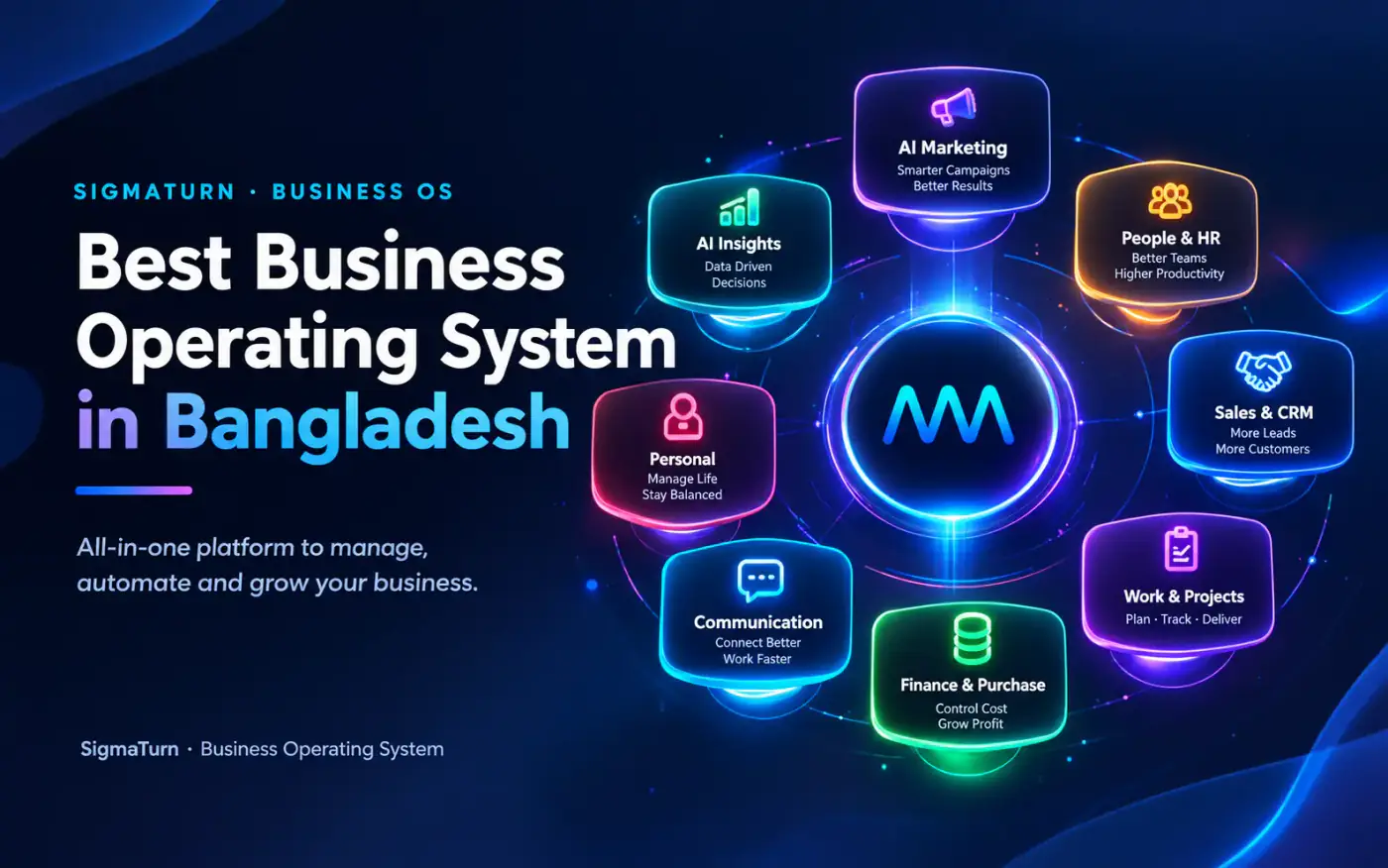
SigmaTurn is GiveTurn's AI-powered business operating system with more than 30 modules across eight categories: People & HR, Sales & CRM, Finance & Purchase, Work & Projects, AI Marketing, AI Insights, Communication and Personal. Its Finance, Purchase and Accounting modules cover invoicing, cash flow, procurement to vendor payment, a general ledger, budgets, and profit and loss and balance sheet reports, and every module shares one data model. Best for: service, retail, logistics and pharmacy SMEs that want one system for HR, attendance, payroll, CRM, projects and finance. Check: SigmaTurn is not a production-planning or garments ERP, and its public pages do not claim NBR VAT-return automation or a Bangla interface, so choose a specialised ERP if those are core needs.
ERP comparison table: which option is best for what?
| Option | Best for | Deployment stated | Bangladesh compliance stated | Watch out for |
|---|---|---|---|---|
| PinTech ERP | Manufacturing, trading, real estate | Cloud and on-premise | NBR and VAT-ready accounting | Bangla UI not detailed |
| PrideERP / PrideTex | Local manufacturing and garments | Verify | Local VAT rules and garments focus | Ask for factory references |
| Biznify | SMEs wanting cloud | Cloud | Verify | Module depth by industry |
| PrismERP | Cloud ERP shortlist | Cloud | Verify | Industry fit |
| G-ERP | NBR-compliant multi-industry | Cloud | NBR-compliant | Demo your VAT documents |
| Odoo | Customisable open source | Cloud or self-hosted | Via localisation and partners | Needs a strong partner |
| SAP B1 / NetSuite / Dynamics 365 | Large or multi-country firms | Cloud and partner-led | Via partners | Cost and complexity |
| TallyPrime | Accounting-first firms | Desktop | Widely used for accounting | Not a full ERP |
| SigmaTurn | Service, retail, logistics SMEs | Cloud | Not claimed on public pages | No production planning or garments workflows |
A 12-point checklist for choosing ERP software in Bangladesh
- 1. Process fit. Does it model your real workflow, from quotation to cash, or from purchase order to shipment?
- 2. Industry references. Ask for three customers in your industry and size, and call them.
- 3. VAT and NBR. See your real invoices, Mushak forms and returns produced by the system.
- 4. Multi-branch and multi-currency. Test both with your structure.
- 5. Payroll rules. Test overtime, leave and bonuses against your own sheet.
- 6. Customisation. How much can be configured without code, and what does custom work cost?
- 7. Deployment. Cloud or on-premise, where data is hosted, and how backups work.
- 8. Integrations. POS, e-commerce, banks, payment gateways and an API.
- 9. Data migration. How opening balances, customers, items and employees get in, and who does it.
- 10. Training and support. Support hours in Bangladesh time, on-site training and response commitments.
- 11. Security. Role-based permissions, audit trail, encryption and backups.
- 12. Total cost and exit. Three-year cost in writing, and a clear way to export your data if you leave.
How should you run an ERP selection process?
- Document your process. List your top 15 workflows and the reports the owner needs.
- Shortlist three vendors. Use the type of business guidance above.
- Demand a scripted demo. Give each vendor the same scenario and your own sample data.
- Call references. Ask what went wrong during implementation, not only what went right.
- Compare three-year costs. Include licences or subscriptions, implementation, customisation, training, support and hosting.

How long does ERP implementation take?
It depends on scope. A simple cloud ERP for a small firm can be running in weeks, while a manufacturing or garments implementation with production, costing and multiple branches often takes months. The main phases are discovery and design, configuration, data migration, training, a parallel run and go-live. Firms that skip the parallel run or under-invest in training are the ones most likely to struggle.
How much does ERP software cost in Bangladesh?
Bangladeshi vendors' own price guides quote a very wide spread, from a few tens of thousands of taka for basic packages to several lakh taka for full-featured or industry-specific systems such as garments ERP, usually plus implementation and support. Global platforms usually cost more in licences and services. Pricing models include per user per month, a one-time licence plus annual maintenance, and module-based plans.
Compare vendors on a written three-year total covering subscriptions or licences, implementation, customisation, data migration, training, support, hosting and extra users. To find out what SigmaTurn would cost for your team, start the free trial or contact the team on the SigmaTurn website.
What mistakes should you avoid when buying ERP software?
- Buying on price alone. The cheapest option can cost more if it does not fit your process.
- Over-customising. Every customisation adds cost and upgrade risk. Change your process where you sensibly can.
- No internal owner. Someone from your business must lead the project and decisions.
- Skipping data clean-up. Migrate clean items, customers and balances, not years of duplicates.
- Going live without a parallel run. Run old and new side by side until the numbers match.
- Ignoring training. Systems fail when the people using them are not confident.
When is a business operating system a better choice than ERP?
If you do not manufacture products and your main pain is that HR, sales, projects and accounting sit in separate tools, a business operating system can give you one login and one data model faster and with less complexity than an ERP. If production, bills of materials, garments workflows or complex VAT operations are central, choose a specialised ERP. Our guides to business operating systems, HR and payroll software and CRM software explain how each piece fits.
Frequently asked questions about ERP software in Bangladesh
What is the best ERP software in Bangladesh?
It depends on your industry. Garments factories usually need a garments-specific ERP such as PrideTex, manufacturers and traders often look at PinTech ERP or G-ERP, large groups consider SAP Business One, Oracle NetSuite or Dynamics 365, and service SMEs may prefer a cloud ERP or a business operating system such as SigmaTurn.
What is the best ERP for the garments industry in Bangladesh?
Garments factories need merchandising, buyer orders, bills of materials, production tracking and export documentation. Pridesys positions PrideTex for RMG, and other garments-focused ERPs exist. Ask for a demo of one order from buyer PO to shipment and references from factories of your size.
Which ERP is NBR and VAT compliant in Bangladesh?
Several local vendors, including PinTech ERP and G-ERP, state NBR or VAT-ready accounting. Compliance claims are the vendor's own, so ask to see your VAT invoices, Mushak forms and returns generated by the system before you buy.
What is the difference between ERP and a business operating system?
ERP is usually built around finance, inventory and production and takes longer to implement. A business operating system starts from people, sales, projects and finance on one data model and is typically quicker to adopt. ERP suits factories and process-heavy firms, while a business OS suits many service, retail and logistics SMEs.
How much does ERP software cost in Bangladesh?
Vendor price guides quote a wide range, from tens of thousands of taka for basic packages to several lakh taka for full-featured or industry-specific systems, usually plus implementation and support. Ask each vendor for a written three-year total that includes set-up, training, customisation and support.
How long does it take to implement ERP?
A simple cloud ERP can be live in weeks. Manufacturing or garments implementations with production, costing and several branches often take months. Plan discovery, configuration, data migration, training and a parallel run before go-live.
Is cloud ERP or on-premise ERP better for Bangladeshi businesses?
Cloud ERP has lower set-up effort and works from anywhere, which suits most SMEs. On-premise gives more control and can suit firms with strict data or connectivity needs. Some vendors, such as PinTech ERP, offer both. Check backups, hosting location and how you can export your data.
Can an SME start with a simpler system instead of full ERP?
Yes. Many SMEs start with accounting software or a business operating system covering HR, sales, projects and finance, and add specialised modules later. Choose a full ERP when production, complex inventory or industry compliance is central.
Does SigmaTurn replace ERP?
For many service, retail, logistics and pharmacy SMEs, yes, because SigmaTurn covers HR, payroll, CRM, projects, purchasing and accounting on one database. It is not a production-planning or garments ERP, and its public pages do not claim NBR VAT-return automation, so choose a specialised ERP if those are core needs.
How do I find out what SigmaTurn would cost for my business?
The cost depends on your team size and the modules you need. The best way to find out is to start the free trial or contact the team through the official SigmaTurn website.
Can I try SigmaTurn before paying?
Yes. SigmaTurn offers a 7-day free trial with full access and no credit card required. You can start it on the official SigmaTurn website.
The verdict: which ERP should you choose?
Match the tool to the business. Choose a garments-specific ERP for RMG, an industry-capable local ERP for manufacturing and trading, a global platform with a strong partner for large groups, and consider a business operating system such as SigmaTurn if you are a service, retail or logistics SME that mainly needs people, sales, projects and finance connected.
Whatever you choose, demand a scripted demo with your own data, call three references, and get the three-year cost in writing.
Sources and further reading
- PinTech ERP, Pridesys and Biznify (vendor claims are their own)
- PinTechERP, Pridesys and Biznify ERP price guides
- Golden Info Systems: Best ERP software in Bangladesh (G-ERP)
- SigmaTurn official website: platform and modules (read September 2026)
- Photos via Unsplash (free Unsplash License): ThisisEngineering and Austin Distel. Downloaded, cropped and compressed to WebP.
Written by the GiveTurn Team
Notes from the engineers, marketers, and product builders behind 1,200+ projects for 500+ clients.